

Josh Feye: Hey, Seth! How are you doing this morning?
Seth Bockley: I’m great. I’m happy to chat. Thanks for coming.
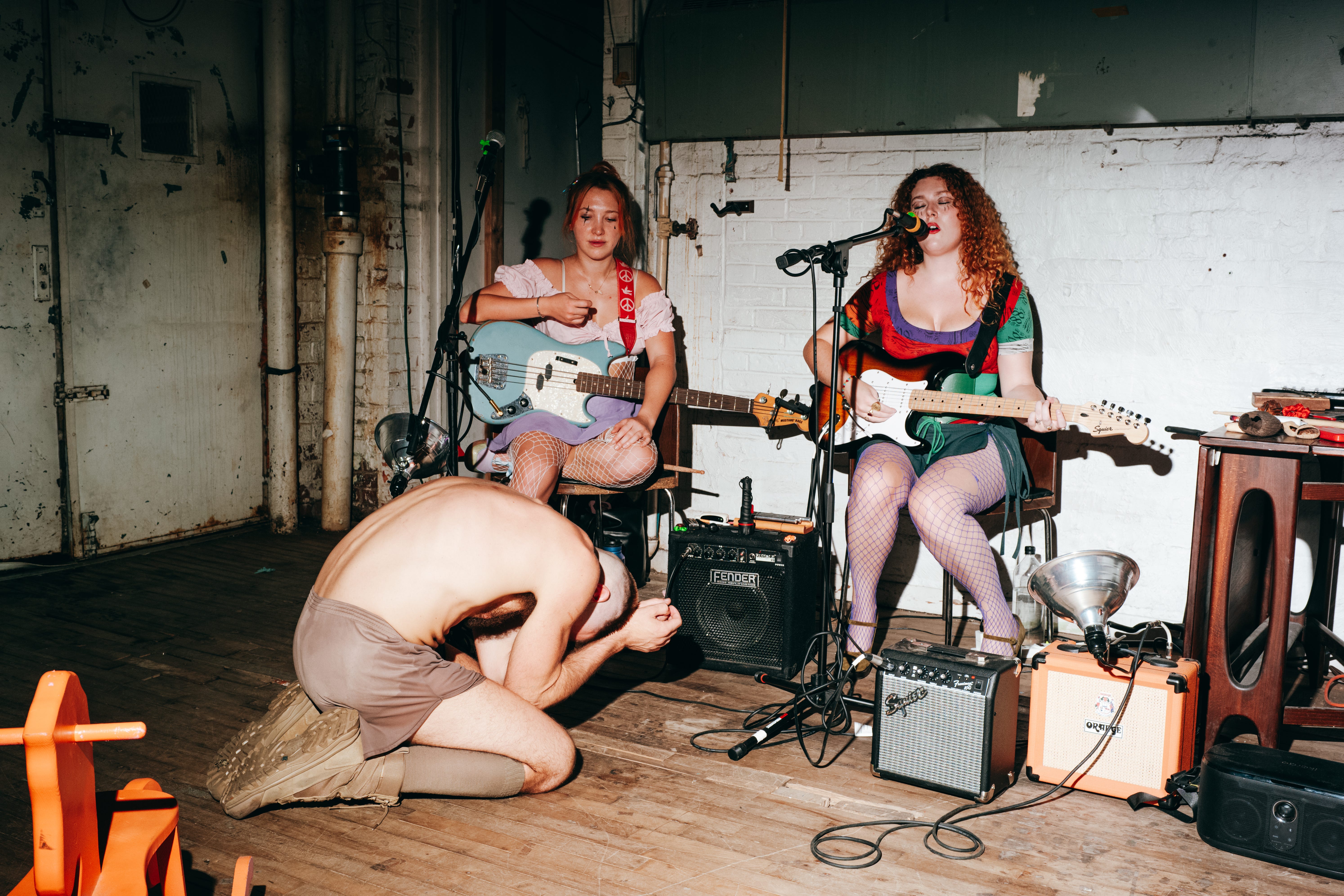
JF: Yes, last night was opening night for Woyzeck, which you directed. It was so sexy and grotesque. I think that this production is kind of a paradigm shift for Adult Film. It’s a deconstructed, grunge rock style, which I’ve never really seen them do in this way. How did you come to this style for the play?
SB: My approach to directing is to find the pulse of the company, to find the heart of the thing in the room, meaning in the bodies and the minds and imagination of the actors and collaborators that we have. In this case, it’s the company. It’s Adult Film, and, as you say, they have their own aesthetic and style, so I didn’t want to impose a style. I wanted to find out what they were doing and play with it, basically, and that’s essentially what happened. I arrived and I said, here’s the text that Ryan (Czerwonko) and Madeleine (Bernhard) and I had agreed on, this wonderful new translation by the late great John Christopher Jones, that we wanted to produce. So, we started by just reading the play out loud as a company, workshopping it several times in the basement. I led the company in a lot of sessions where we would sit in a circle and just play music and make sound and sort of approach it as a radio play. For me, this really seemed to open up the text and seemed to open up the performers, many of whom are musicians, and so that’s how we began. We found that there was a lot of music in the play.
JF: And why do you think that there is this sort of cultural resurgence toward rock music right now?
SB: There’s nostalgia, but there’s also just… a kind of immediacy and raucousness that is wanted maybe by terminally online people on their phones that want to not only be loud and go to loud events, but jump around, push each other around, and be physical. I think that has to be part of it.
JF: Yeah, totally. Speaking of physicality, I think this play has a lot of great physicality. Humans are acting like animals; there’s a lot of dancing. How did you find those moments?
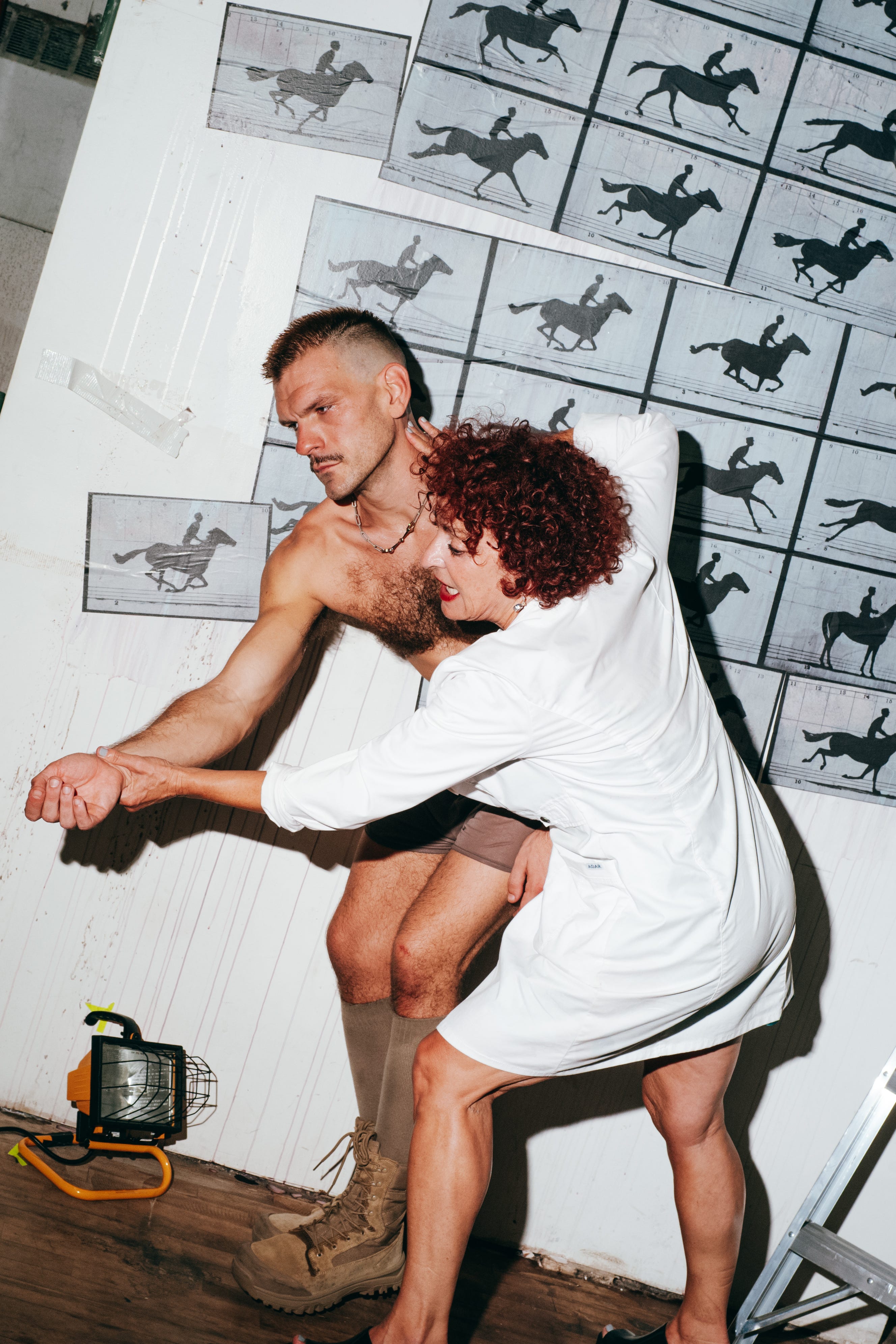
SB: So both the animal stuff and the music stuff come from the play. Büchner wrote folk songs into the script. I think there are four or five lyrics in the play, and we use those. We combine them with... there’s one lullaby, for example, that we combined with a Courtney Love song. The physicality you’re asking about is also from the play. For example, Woyzeck says repeatedly, “I can’t stop moving, dancing, dancing, on and on.” This language is descriptive of a physicality, and there’s no way to really perform the play without investment in embodiment and movement, kineticism, let’s say. I think anyone can choose how much dance or movement or marching or military drills to include in a production of Woyzeck, but I think there’s got to be a bit of that. The doctor is obsessed with his body, his pulse, his muscles. It’s so physical. Our amazing designer Josh Barillanot not only built a transforming platform and determined the layout of the space, but also did amazing visual research. His concept mood boards are beautiful collage artworks, and they include a lot of animals. Early on, Josh and I, along with the actors, went really heavy on animal exploration, especially the motif of the horse. The final line of the play is, “Hop hop, horsey, hop hop.” It seems to be alluding to a kind of children’s game that Woyzeck is suggesting that the idiot play with his infant child, or perhaps with a hobby horse or something like that. This feeling of a beast of burden, that Woyzeck is himself an animal and that humans are animals, that we’re being put into a show like the Clever Hans horse who counts out the time in a trick, or as a soldier who is a kind of animal trained to kill like a dog, this image of the domesticated or confined animal, the beast of burden, was a major motif. So we chose the horse. We found an orange rocking horse in an alley. We brought it onto the stage, and then we printed out a bunch of Eadweard Muybridge photographs of horses running to allude to that sense of the beast of burden.
JF: Yeah, and I’ve been thinking about this a lot since I watched it last night. Franz, played by Ryan Czerwonko, is kind of in this battle between his nature and morality. A lot of this play is whether or not he should follow his nature. What do you make of that? How does that speak to what we’re living through right now?
SB: Nature versus nurture, being wild versus being domestic—these are tensions that never go away in the human condition. I think we’re always only a step away from a state of nature. There’s a pessimistic or cynical way to look at that, which is to say we’re just creatures of instinct and we’re always one step away from murder or any other number of antisocial and selfish behaviors that are just feeding our beastly nature. There’s a lot of sex in the play. Sex and violence are the obvious things that come to mind as these animal instincts that we seem always so close to and that appear to be just below the surface. For me, the tension between civilization and nature is false because civilization, in part, is a way to channel animal instincts, but also to accommodate them. Rituals of sex and seduction, even prostitution, but also other forms of more formalized courtship and sexuality, like going to a dance club and dancing and going into a mosh pit, are all parts of civilization. They’re not incidental. They’re actually essential parts of civilization just as much as building a road or an aqueduct or power lines. So I feel like it’s not that we’re hiding our animal selves underneath civilization. I think we’re trying to live with it and make room for it in a healthy way. I think the play shows a kind of sick society, and there is something to study in it, from a kind of Brechtian point of view almost, where it’s like, “Hey, look at how these people are handling this. This isn’t going so great.” Woyzeck becomes a tragic figure because, as I’ve said to the cast a lot, it’s a little like a classical tragedy where, if one thing had just gone a little differently, you have the feeling that the murder could have been avoided. There’s a really poignant moment where Andres says to him, “You should be in a hospital,” which is just heartbreaking. This is late in the play after all this insane, zany stuff has been happening with the doctor making him eat peas and the captain making him shave him and bullying him about his wife’s infidelity. Even at the end, Andres, very ineffectually but very heartfeltly, says, “You belong in a hospital.” There are hospitals in this world, and we feel like civilization is just not quite working here. People aren’t quite looking out for each other enough, and the systems aren’t quite working, and so the tragedy unfolds.
JF: Yeah, and this play is sort of the precursor to naturalism and realism, and Büchner didn’t finish it. He died before it was published and produced. I’m curious, did that free you at all to be able to make this whatever you wanted to make it?
SB: Yes, it does. It’s incredibly liberating. There’s a reason why theater directors are always attracted to this play, and I think you put your finger on it. It gives you a lot of latitude because we don’t even know what order the scenes are supposed to go in. There aren’t stage directions that impose the playwright’s tonal thumb on it. It’s really something you can mold and play with. It’s incredibly liberating to have the flexibility to move scenes around or add songs or invert things, play with them, while staying very loyal to the text itself that John Christopher Jones translated. I had a lot of fun feeling free not to think about the writing and just to let the wonderful gaps and spaces that exist in the play live as a space for dreaming and imagination and nightmares and music.
JF: When did you first come across this play?
SB: I read the play in college, a long time ago, but it was a different translation. I’ve also been familiar with the opera Wozzeck by Berg. There’s a beautiful production by William Kentridge, a South African director, with a lot of shadow puppetry and video design. He’s a wonderful visual artist and stage director. So I was familiar with the story mostly through theatre history texts and then through Kentridge’s production of the opera.
JF: And I heard that you and Ryan met in Chicago doing storefront theater. Did that time influence this production?
SB: One hundred percent. Madeline is another Chicago person, who plays Marie, and the three of us have bonded over this a lot, actually. We keep coming back to the Chicago spirit when we talk about how we approached this particular play and why we get along so well. Ryan and I crossed paths in Chicago in storefront theater, and like a lot of people, we were working in a number of contexts. I would do very DIY, scrappy productions in warehouses in Chicago, and then I would also work at the Goodman Theatre and with Steppenwolf and these bigger theaters. Ryan is the same, and we always had that taste for working across a range of styles. Also, we share a deep appreciation for the company aesthetic of Chicago, this feeling of scrappy people who just graduated from Northwestern or somewhere, who moved to Chicago to start a theater company. I know a number of people have done that and had amazing success and found a real style by working with the same group of people, as opposed to the highly professionalized New York approach to acting where you get an agent, go to any audition that will take you, and try to get commercials and do that. There’s a company aesthetic in Chicago that comes from the fact that sometimes you have these groups of friends who just want to play together.
JF: That definitely feels very rare in New York, but it is happening here, and you can see it in Adult Film’s work and history.
SB: Yeah. I’m new to working with the company. I taught a class there last year, and Ryan and I have been friendly since I got to town. Madeline also pretty recently came from Chicago herself, so when we found this play and when we found the space, Modern Sweater, it just felt like the stars had aligned in terms of investigating this storefront theater aesthetic. This is my first time working with them, but it’s been delightful to feel how committed everyone is. I was talking to a friend who just saw it the other night, and they said they could just feel how much everyone wanted to be there on the stage. That seems like a very basic, obvious thing, but in fact it isn’t always obvious.
JF: Can I ask you some Dionysian Dream questions?
SB: Totally.
JF: Do you have a favorite film about the theatre?
SB: A film that comes to mind is The Lives of Others. It’s a movie about East Germany and the Cold War. Beautiful. I just rewatched it recently. This actor who plays the Stasi captain, Ulrich Mühe—his character is assigned by the Stasi to spy on a playwright and his partner, who is the leading actress of a theater company. It’s an amazing portrait of intimacy, loyalty, and intrigue. It has one of the most tragic and beautiful endings of a film I’ve ever seen.
JF: Did it influence Woyzeck?
SB: I’m more influenced by films, per se, than I am by films about theatre. Werner Herzog’s Woyzeck definitely influenced us. I feel like films that are play-like often attract me because I’m a theatre artist, so I can feel their DNA. I was just talking to my dad this morning about Gaslight, the movie, which of course is based on a play, and how that compression of space… I think, as a theatre director, I’m often influenced by films that have that kind of claustrophobic, single-set feeling. But as an artist and just as a human being, I’m extremely influenced by filmmakers whose work is wildly cinematic, like Werner Herzog, works that take us into nature. I love his Nosferatu, for example, with Klaus Kinski. I think Herzog is an influence on me and on the company. His depiction of the animal world is really notable, especially in Nosferatu. There’s a lot of animals, this feeling of Dracula or the vampire being able to transmute himself into a bat or a rat, these classic scary transmutations. I think that really influenced the animal kingdom material in Woyzeck.
JF: Is there a theatre artist, living or dead, that you’d like to have a night on the town with?
SB: I would love to go out with Spalding Gray.
JF: Oh, yes. What would you do together?
Seth Bockley: We would walk around New York. That’s my dream. We’d walk around New York. Maybe we’d take a ferry to Greenpoint. I’m imagining Spalding Gray having not died, successfully conveyed on a ferry from Manhattan to Greenpoint, where I live. I’d take him to Transmitter Park, which is my favorite park, and we would look at the skyline and talk about theater and art and life. He’s a really inspiring person for me. We have some things in common. We both grew up as children of Christian Scientists in New England, and I did some solo performances when I was young. A lot of my explorations of faith and spirituality and family have to do with that legacy that he also wrestled with in his writing.
JF: What are your dreams for the future of the American theatre?
SB: More rock and roll. More joy, more ensembles, and more site-specific work that reflects the city where we live. I’m really a big fan of theater taking the same approach that music does, that nightclubs do, in terms of going where the culture is, going where young people are, going where the energy is, and building from that energy. I hope that the American theatre will occupy old factories, abandoned buildings, storefronts, alleyways, streets, and public plazas, and wake people up in terms of their perception of the places that they live. I hope specifically for New York that there is a flourishing of actor-driven companies based in Brooklyn, based in Queens, where so much of culture is happening and growing and fermenting. I hope that a million Adult Films may bloom, with cousin companies popping up all over here the way that we do in Chicago.
Follow Seth on Instagram.
Woyzeck runs through August 15th at Modern Sweater in Ridgewood.