
A Director Prepares (LD's Version)
Director L.D. Kelley talks Dram-O-Rama, their favorite plays, and ON THE EVOLUTIONARY FUNCTION OF SHAME.

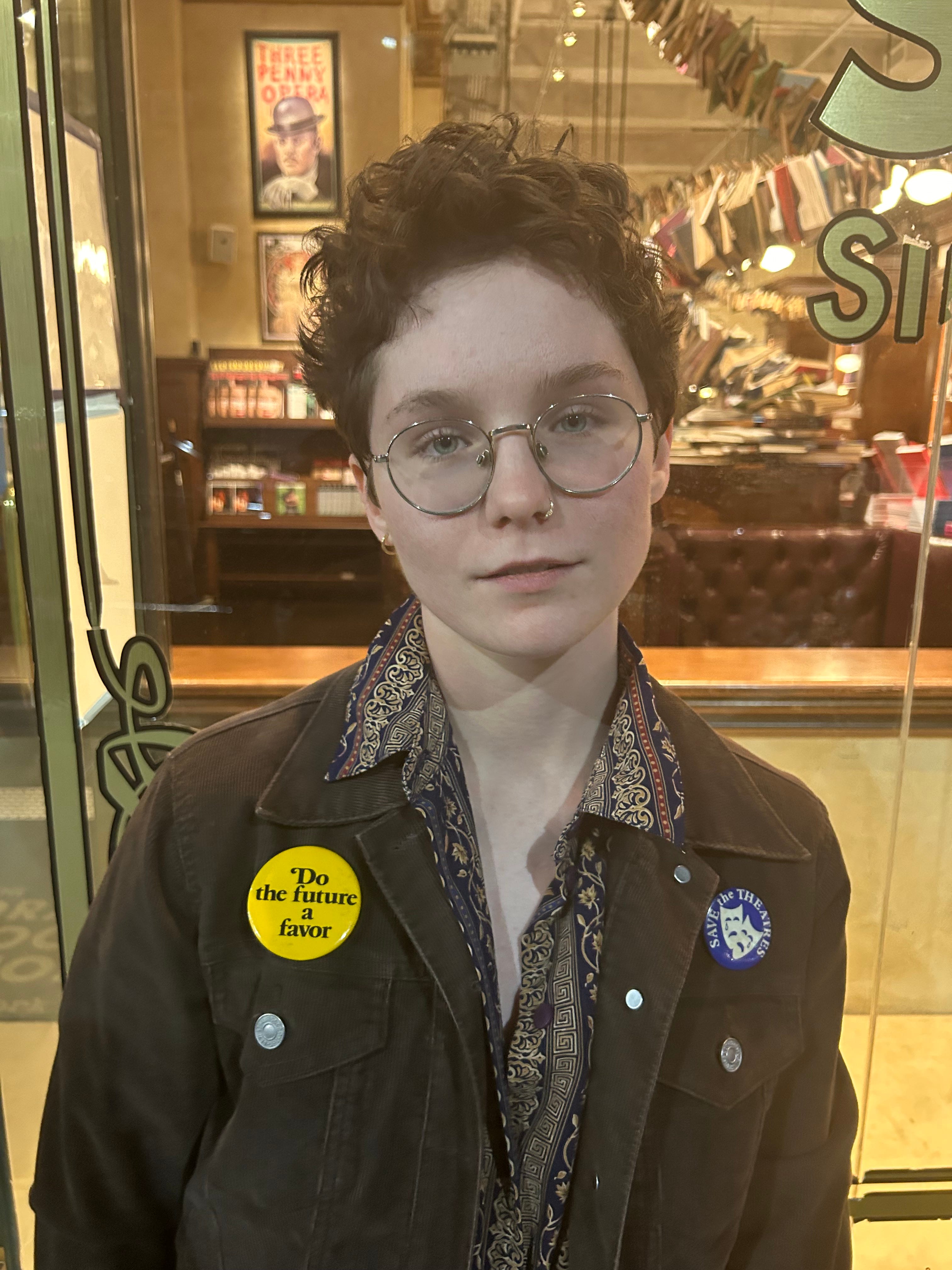
JF: Here we go! Hi, LD. It’s so good to see you.
L.D.: Hi! It’s good to see you.
JF: Here at the Drama Book Shop!
L.D.: I know. We used to come here all the time. I walked in, and it felt like I was stepping into a memory. That first summer you were here, we came a lot.
JF: You were always here planning for Dram-O-Rama. We would hang out, and you would peruse over scripts.
LD: Organizing my illegal digital library.
JF: What was the impetus for Dram-O-Rama?
L.D.: I was working as an usher at the Hudson. I had a lot of amazing co-workers who were actors, writers, musicians, and we had a lot in common. I wanted to become friends with those people. You know, when you first move here from anywhere, you feel isolated. I wanted to make a community for myself, especially with other artists. I found that I would try to speak to other artists my age about plays, and we didn’t have the same reference points. We had gaps in knowledge. They knew plays I didn’t, and I knew plays they didn’t, and we couldn't talk about theatre the way I wanted to. And it was approaching Summer, and I wanted to spend more time outside. So, I decided I would start a theatre book club. I always wanted to be in one. I spent hours walking up and down the Hudson, trying to find the right spot for it to be.
JF: Oh, wow.
L.D.: I knew I wanted it to be outside, and public space in New York can be hard to find, especially a place accessible for people who live in Manhattan, Brooklyn, and Queens. That’s where most of the membership base is from. So, I found the spot, and then I had to call it something. I wanted it to be its own thing. I wanted this Bacchic feeling since we were outdoors and all my friends were young and raucous. We’re all getting drunk and high, sitting outside reading plays. So, I called it Dram-O-Rama.
JF: It has a 1960s disc jockey feel to it.
L.D.: Yeah, something is exciting about it. It came to me suddenly.
JF: The best titles do.
L.D.: But to answer your question, I was lonely. I wanted to make friends with whom I could talk about theatre, and I wanted to address what I saw as a gap in the knowledge of the people who were my peers. I was like, “You don’t know about this play?” And they were teaching me things too and could say, “I know this script. Our group should do it.” Initially, I think we got a maximum of 5 or 6 people who would come every week.
JF: I don’t go to many script groups, but what feels different about Dram-O-Rama is you immerse the readers in the world of the play, like when we read Anne Carson’s Bakkhai.
L.D.: Oh my god! That was so fun.
JF: There were candles, drinking games, and we chanted to Dionysus. It was wild. I’m not aware of other script circles doing it like that.
L.D.: It’s evolved a lot over time. At our first meeting, we met outside. Someone brought a joint, and we watched the sunset over the water and read Christopher Durang’s BABY WITH THE BATHWATER. It’s such a high-stakes, incredibly strange thing that most of it was like, “Oh my god! We’re reading this crazy play, and we’re kicking it. It’s summertime!” I’ve got my tank top on. That was so beautiful. I’m directing a play right now; one actor is a Dram-O-Rama regular. Maddy Rolon, a fantastic actor, told me yesterday that Dram-O-Rama invites or encourages a specific type of person because there’s no reward. Ultimately, the only reward is spending time there and the people you meet. It just attracts an acute kind of passion in that person. Over time, it became less about hanging out and more about pushing ourselves to understand the text and ourselves as artists in a new way.
JF: When I attended Dram-O-Rama, I noticed your director “self” emerged. The way you talk to the actors is exciting. You create a space for them to try things.
L.D.: It’s important to me. What I love about it is that there are no stakes, and everyone is so nice. People will try anything if you give them the opportunity to. Many people in the group were not actors; they were very nervous the first 2 or 3 times they came and constantly stumbling over their words. Over time, they became more comfortable with it because the second you step into Dram-O-Rama, you’re taken very seriously, even though you may not have performed in a play before. One time, my mom came, and she killed it. We were reading DNA by Dennis Kelly. I think I cast her as Mark. And when you’re in a group of people who want you to be good, it makes you believe you are good so you can try new things. I have a lot of fun taking part in shaping that. Most of these scripts are scripts I really love and know well. I can adjust the style, or we might do the scene again with a different understanding of the relationship. Sometimes, it falls flat and doesn’t work, and sometimes, you’re in a room full of people, and someone says something a specific way, and we all react. We show up in that space eager to react.
JF: Right!
L.D.: How rarely do you get to be in a play as an actor in New York? And now I have this arsenal of actors, which is special. This arsenal of brilliant and mostly queer actors who love theatre so much they want a place where they can be trusted with a role and try something new on a cold read. We’ve done well-known scripts, but I usually try to pick scripts that are not as well-known. Most of the time, the people in the room would never get to play those roles in real life, so they’re getting a crack at these parts; otherwise, they never would.
JF: You mentioned you choose a lot of plays you love. Do you think Dram-O-Rama is an exercise in building a canon for yourself?
L.D.: Maybe a little bit. But now I consider the cast size and the people who will come. I also try to pick plays based on what’s happening in the world then. We’re doing THE IMPORTANCE OF BEING EARNEST, which premiered on Valentine’s Day in 1895, the week of Valentine’s Day. I also like to do plays that I liked in high school. We did ALMOST, MAINE a couple of weeks ago. I like to do plays we roll our eyes at, but you can find something meaningful when you return your attention to it and act in it.
JF: What plays do you return to, which give you something new or invigorate you every time?
L.D.: God, there are so many. How do I pick? One of my favorite plays of all time is HIR by Taylor Mac. Seeing it at the Unicorn Theatre in Kansas City opened my eyes to what theatre could be. At that point, I was openly lesbian, but I didn’t know I was trans. When I think about the work I return to, I don’t think about specific plays as much as I think about specific playwrights. I’m inspired by Christopher Durang, Annie Baker, and Suzan-Lori Parks. I believe FATHER COMES HOME FROM THE WAR PARTS 1,2, AND 3 is one of the most genius plays of all time. I love Annie Baker’s THE ANTIPODES. Even though it’s one of her least celebrated, she really went there with this science fiction boardroom structure. It works for me.
JF: I like that she captures the essence of storytelling, why we tell stories, and what makes a story work.
L.D.: And I think most of the time when playwrights insert a writer character in their writing, they’re usually thinking about their work or telling you something about their thoughts or their role. What Annie Baker does so well is she puts so many different storytellers in a room and stretches it out in all directions. And it’s unclear what she believes her responsibility is in art if any of us have a responsibility in art. I love all of her plays. I also love Federico Garcia Lorca.
JF: Ugh! Our boy. I adore him. I’m waiting for the Lorca Renaissance.
L.D.: It’s coming. I think this Summer it will happen.
JF: Have you read THE PUBLIC? It’s one of the plays he deemed “unproducable.” A director is staging a production of Romeo and Juliet with a same-sex couple. The technical elements are intense.
L.D.: Oh my god. I’ve gotta read it. ROMEO AND JULIET is one of my favorite Shakespeare plays.
JF: Oh, interesting! Why?
L.D.: There is no logic to love and there is no logic to sex. It’s interesting how many people approach that script with skepticism and suspicion of the lovers and barely any mention of the violence from the aggravators. Interestingly, you can be walking down the street in New York, and there will be a fistfight happening, and no one will bat an eye, but if you see two people kissing on the street, someone will say something invariably. “Get a room!” “Do you have to do that out here?” People always say things to discourage love but very rarely to deter violence.
JF: Can we shift to ON THE EVOLUTIONARY FUNCTION OF SHAME?
L.D.: We can!
JF: What is it about?
L.D.: It’s a new play by D.A. Mindell that follows Adam and Eve in the Garden of Eden immediately after eating the forbidden fruit and a pair of modern-day twins named Adam and Eve. Our modern-day Adam is a pregnant Trans man, and his twin sister Eve is a genetic researcher who has just discovered the gene for gender dysphoria. It’s a play about eugenics, neurodivergence, transness, fractured familial relationships, desire, the nature of shame, and shame as a tool of social cohesion. What I appreciate about the play is that it exists in this realm of logic that allows us to ask ourselves tough questions about trans issues without fear.
JF: And how is the directing process going?
L.D.: It’s going well. It’s also incredibly terrifying. It’s a workshop for a new play, which is always exciting, and already has a life beyond this production. It will be in the Second Stage Next Stage reading series with some amazing talent on February 26th. I went from directing a different play every week in a library on the second story of a building in Chinatown to now having a budget for costumes. I haven’t directed a full play since 2019, so in many ways, I’m getting back into that process and refining it, which I think is important for anyone who fancies themselves an artist.
JF: What is filling your well to help you do this project? What is inspiring you?
L.D.: The people I’m doing it with. I have a stage manager who reads my mind. I have a playwright who is always open to my ideas and has fantastic ideas. I have actors who trust me and who I can trust. They’re so passionate about the play.
JF: When you were in preparation for it, what ideas were you spinning with to help you direct?
L.D.: The play is essentially two in one. You have all these scenes that take place in the Garden of Eden in human pre-history as these characters discover the invention of shame, nakedness, lust, death, and murder. They trust each other, need each other, and have each other forever despite how betrayed Adam might feel that Eve ate the apple and convinced him to do the same, regardless of the devastation resulting from that choice. They are steadfast and loyal to one another and have a simple, loving relationship. They complete one another, and when you go to these modern-day scenes, which take place in Atlanta, Georgia, you see human beings dealing with institutions like education, hospitals, and research, but in addition to those things, complex identities like being trans or being Jewish, or being autistic and all of the ways those identities are dealing with things day to day that make it a lot harder to relate to one another. Through the development of this play, I’ve been interested in how we’ve created these institutions and identities to protect ourselves from nature and make more sense of our day-to-day lives. But it’s made it harder to have a regular conversation, trust one another, and feel understood.
JF: I was recently listening to a conversation with Sarah Ruhl and Sheila Heti when the idea of social institutions protecting us from nature came up. The chaos of nature is too much.
L.D.: Yeah, we’re so afraid of our desires and impulses.
JF: You need to get into Sheila Heti. She will change your life.
L.D.: Clearly, we have a lot in common already.
JF: I’m reading her book MOTHERHOOD right now, and it’s all about whether she should follow what her body wants.
L.D.: In a similar vein, one of the protagonists of our play is a trans man who is pregnant and dealing with the sort of dual struggles of the regular fears of parenthood, but also voices from all sides saying this is not what you’re supposed to be doing.
JF: Yeah, there’s a part in MOTHERHOOD where she talks about how men want to control women by restricting access to abortion, but then women pressure other women to have babies. So, the driving impulse is always having babies.
L.D.: Have you ever read SEX AT DAWN?
JF: No.
L.D.: I think you would love it. I’m thinking about this a lot because SEX AT DAWN is a non-fiction science book about the evolution of human sexuality. The reason that we’re such a sexual species now is that we’ve evolved to be a hypersexual species. We’re supposed to be living in these omnisexual multi-orgasmic multifamily traveling foraging communities. We’ve evolved to have this lifestyle, but because of the invention of agriculture and the nuclear family, we have a heightened concern for paternity because we believe our direct children are the only people who should have access to the resources we’ve hoarded over time when we should be sharing our sexual partners and taking care of each other's children.
JF: I could see how that would be limiting to an individual, but at the same time, I do see people yearning for that sense of connection the Agrarian era provided.
L.D.: Which is why the title of this play is so apt. It’s on the evolutionary function of shame. It’s nothing more than a tool to get us to cohere with one another socially and agree. Shame comes from all sorts of things. But I’m interested in evolution now, which is why this book, Sex at Dawn, has come up at the perfect time in my life and why so much of that animal instinct feels baked into this play. Not even the play itself or the play you’re likely to see is overtly sexual, but there’s this uneasiness under everything. We want to rip each other's throats out and connect, but we have so many things distracting us from genuine human connection. Now, feeling your gender identity is misunderstood is a reason many people cut off their families. It’s incredibly difficult to be a human right now because we attach so much importance to our identity and sense of self.
JF: I’m trying to stay optimistic.
L.D.: Only time will tell.
JF: Why can’t it be magic all the time?
L.D.: To me, magic is gratitude, attention, awareness, mystery, romance, and curiosity. Magic comes from a childlike sense of wonder. We live in a hyperscientific age, and we live in a chaotic time where people are no longer looking to religion to answer their questions. They’re looking to science to provide them with something logical. I also think magic requires a little bit of structure. So, I believe there is magic around us all the time, but we can only look for it if we feel supported to find it.
Get tickets to ON THE EVOLUTIONARY FUNCTION OF SHAME at the Second Stage Next Stage Reading Festival.
Follow L.D. on Instagram.
Follow Dram-O-Rama on Instagram.