

Hannah Hale and Madeline Bernhard: Hi!
JF: How are you guys today?
HH and MB: Good. How are you? We’re saying the same thing at the same time. Sorry.
JF: It’s okay (laughs). Congratulations on Woyzeck! It was really great. It was so successful for Adult Film. How are you guys feeling about it all?
MB: Honestly, Josh, I still feel a little insane. We didn’t anticipate how successful it would be. You always believe in your work, and you’re like, yeah, this is gonna rock, but then I was like, oh, people like, I’m like, why do you wanna be here? Why are you here? So it was kind of an insane effort that I’m still coming down from. We closed last Wednesday after our second extension, and it doesn’t really feel real that we’re not doing it anymore.
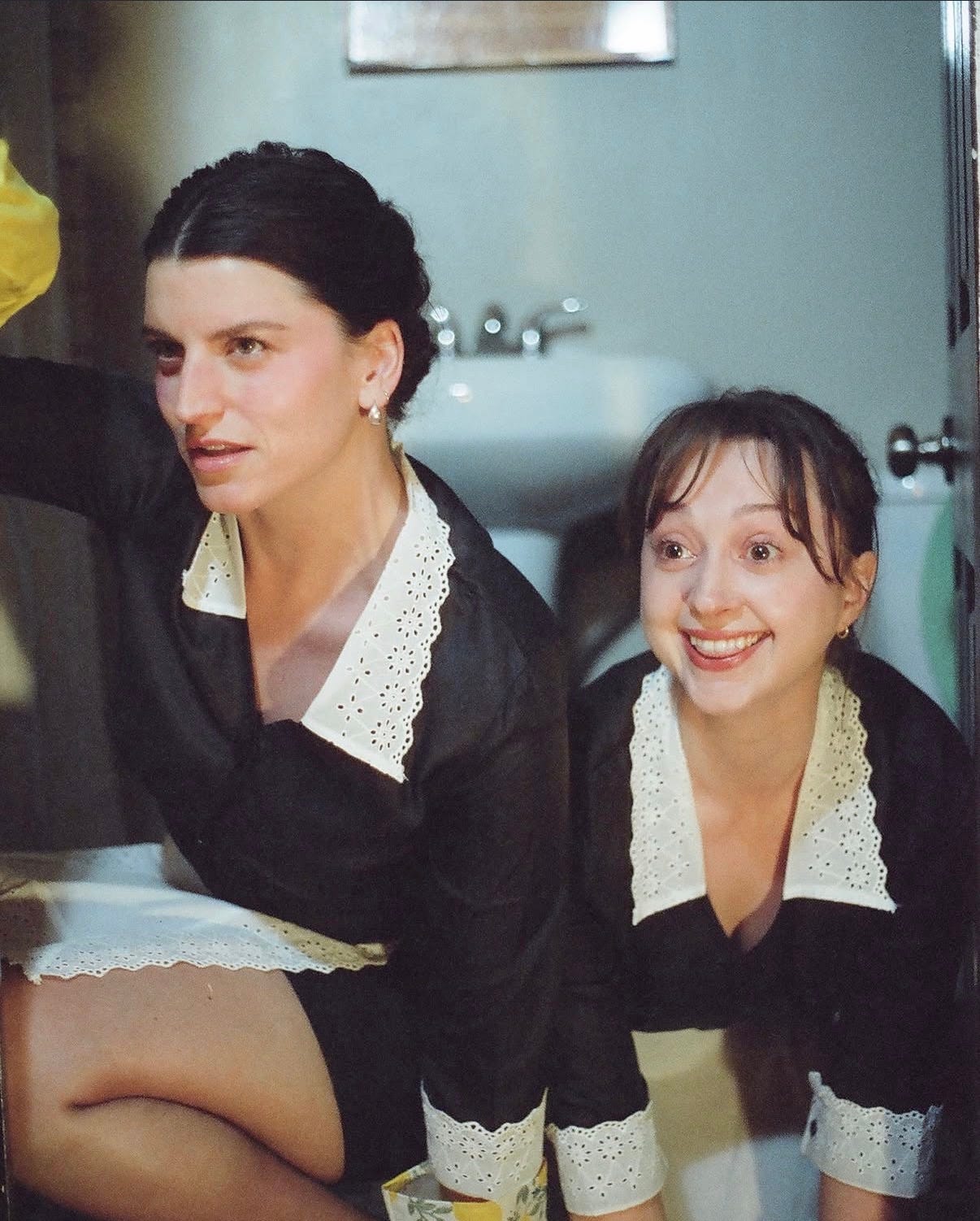
JF: Yeah, and you’re going right into Jean Genet’s The Maids, which is under the Studio Darlings series. It’s a new series for Adult Film. Can you talk a little bit about what it is and why you chose The Maids as the first production for Studio Darlings?
HH: Yes. I guess it goes back to the whole ethos of Studio Darlings. It really comes from how we work together in Ryan’s evening class. We have classes here at AF, and his evening class is filled with many, not everyone is a company member, but a lot of them are, and it’s a class that stretches over months, and we work together very intimately. I guess we sort of thought, well, what if we take how we work in that way? What if we build some productions out of the work that comes out of this specific class? Madeleine and I were scene partners over a year ago in this class and worked on a scene from Uncle Vanya. I guess we just really hit it off and realized it was sort of like looking in an artistic mirror for both of us. And so we’ve worked together a few times since. It was actually Madeleine’s idea. The Maids came to her, and she was like, have you read this? What do you think about this? What if we worked on this together? And then, after chatting with Ryan, this is sort of where it fell on the calendar. There were a few other pieces that were also coming out of this class that we thought, oh, that would make a good show, and what if they were all one hour and ten minutes? They were all in the basement, which is a really intimate space where we have control over what’s going on and everything. And it’s like what we do in class, but at a production level.
MB: And I can speak specifically to the inspiration to work on The Maids with Hannah. We have a lot of filmic references at AF, and as we’re working on, yeah, obviously, right, as we’re working on like Chekhov or Sam Shepard or Tennessee Williams, we’re often bringing in these outside filmic influences to the theatre work. One that comes up frequently is Persona by Bergman. Hannah and I were Helena and Sonia in Uncle Vanya, and it really was this kind of folding into each other and becoming each other and loving each other and hating each other, and using this outside force of a man as our conduit to mesh through this scene. And working in that way specifically, I was like, God, this is reminding me so much of The Maids, right? Because so much of it is about identity and who is who and meshing together. And in the way that we work, we always say it’s good to have that minimum 20% of the other character in your character. And so Hannah and I are often very interested in taking ideas to their fullest extent, and sometimes that means it’s successful and sometimes it means it isn’t, and trying to follow the line of thought. And so one of the lines of thought there is like, OK, what’s one of the most Persona-like plays out there? It’s The Maids. So, that’s kind of where that came from, that initial germ.
JF: When I saw that you guys were producing it, I thought to myself, that is perfect. This is so in line with what Adult Film is. And I noticed that the title says it was inspired by Genet’s play. So what does that entail?
HH: I think very simply, it’s taking what Jean Genet perhaps intended and flipping it on its head and perhaps taking everything to its most extreme within these themes that we like to explore.
JF: And Maddie, you’re playing Solange, and Hannah, you play Claire. A lot of the play is the two of them playing games with each other. And I’m curious if you guys are using that structure of play and game to discover the play itself in rehearsal.
MB: Yes, we’ve got some really weird things. I don’t think we’ve had one rehearsal where the same thing has happened. Yeah, it’s all just one giant game, isn’t it? Certainly, there’s a lot of games being played that are intentional, a lot of playing games with each other, a lot of testing. And also this question that I’m constantly, that I’m really intrigued by with The Maids as a play is when they talk about the ceremony and this ritual, right? But when does the ceremony become a game or vice versa? And what’s the difference between a ceremony, which is a very rehearsed event, and a game where anything can happen? So we’ve certainly been playing with that a lot in rehearsal.
JF: And another thing about The Maids is the class conflict, and a lot of Adult Film’s ethos is sort of their working-class roots, and I’m curious, are you wanting to emphasize that in this production at all, or are you honing in on the identity and reality aspects of the play?
HH: Well, yes, I mean, it’s certainly a focus. There’s quite a physical metaphor for it, and Josh, I hope you get to see it. I feel like you’re not able to. I feel like I read that in an email.
JF: Unfortunately.
HH: We’d love for you to see it, but that’s okay. But there’s quite a physical metaphor in the play in terms of the upstairs downstairs, class warfare that Genet speaks about. So yeah, it’s certainly, it’s very much, it’s a very strong influence.
MB: And I also will say, I think the class conflict is just so inherent in the bones of this thing, that even if you do decide to put a lens on another facet of it, it’s always going to be a part of the piece. So another thing that we are exploring too is we’re working with another great actress, Ariana Afradi, who’s playing Madame. And the three of us now have been at AF for about the same amount of time, and kind of all been a part of the company in that way together. And something we’re really interested in is that, yes, there is this dichotomy between Madame and the maids, but they actually are so much more similar than they think, and it really is just whatever access they have in the different parts of their life that are leading to these struggles, which I think is true in the world as well, right? It’s like when we actually have access to things that help us to unburden, and Claire and Solange don’t have that access. They’re under immense, immense pressure, but truthfully, so is Madame under the guise of just being this, sorry to say, fuck-ass Monsieur’s wife. So it’s kind of like if someone oppressed is oppressing others, like that’s classic. She’s a massively depressed stay-at-home girlfriend.
HH: Yes, we’re kind of envisioning her like an Upper East Side recluse or something. She’s like a crazy Real Housewives of New York housewife.
MB: Yeah, yeah. So, I mean, this, I don’t, I hope you don’t think this is like a cop-out to your question. It is something that is often in the room, and whenever working on Genet, he so famously was dealing with the working class and oppressed peoples that it’s just so inherent in the work no matter what the focus is.
JF: No, I think it’s a really fascinating take on Madame and how she is also a part of this structure because it’s inescapable. The play also is dealing a lot with gender, and initially, Genet wanted the characters of Solange and Claire to be played by young boys, but is that just a dramaturgical footnote?
HH: It’s not not something that we’re thinking about. That knowledge is ever present, and to be quite frank with you, I’m not sure if it’s revealed itself how, how it will play into this version of ours, but I have a feeling it’s gonna reveal itself. I’m sure it will make its presence known in some way.
MB: Yeah, have you read the Sartre essay, Josh?
JF: No, I haven’t.
MB: There’s a fantastic essay that he writes about, because obviously they were friends, so he had a really intimate understanding of Genet and his work and his approach. But yeah, his essay in particular has been a real inspiration for Hannah and I on this project. His argument is that the play is much more about identity than it is about class warfare, though it is about that. And so, how does that factor in, and identity and performance also, which, going back to the three of us and the opportunities when we play Madame versus playing each other versus playing at being ourselves. Yeah, it’s fascinating. You should definitely take a read.
JF: I will. You both are also directing this, so how are you finding directing it as you are acting in it? Does it feel sort of just like you’re being in one of Ryan’s acting classes?
MB: That’s an amazing question, Josh. We created a character in the room who we put on the hat when we’re directing, and her name is Sally. She actually is like, imagine if Sally Draper of Mad Men was like 60 feet tall. So, when we’re putting on a director’s hat, we go, OK, we’re playing Sally now, and we will offer each other notes, we’ll offer ourselves notes, but it’s been, honestly, one of the most unique ways that I’ve ever acted in a piece because I often work with a traditional director setting. So I think one of the things about Studio Darlings in particular, of looking at Adult Film as an experimental lab, is, okay, we are taking our work into our own hands. And it’s not that we don’t want to collaborate with other people; of course we freaking do, but as we’re trying to make our own work and explore these themes that we’ve been talking about, again, the furthest extent of the idea is like, well, let’s see what the hell happens if we direct ourselves in this. And so I think Hannah and I have, we’ve been throwing shit at the wall and working in a very sketched-out way in the room when it comes to blocking, but we’ve really been working in pictures and stage pictures and bringing in images from these outside sources that we then attempt to embody. And we are gonna have some outside eyes in the room just to see what the hell we’re making, but we’re kind of like, let’s see what happens if we put ourselves in a little crucible and make the damn thing ourselves.
HH: And we always talk about how Adult Film is an acting company first. It’s a company that’s filled primarily with actors, although that is rapidly changing, but I think it’s important, especially nowadays where everyone has to be a multi-hyphenate, for actors to know how to direct. And it’s important to know how to direct yourself because you never know when you’ll be in a situation where you’re just not getting much from your director, and so it’s important to have a point of view on stage. And so the fact that if you’re able to step outside of your own actor body and be Sally for a moment and look at the big picture and how you fit as a puzzle piece into the larger picture, I think is really important.
MB: And last thing I’ll say about that too is I think it has really freed us both of the ego of acting because it’s always there, whether you like it or not. You’re always like, I’m not gonna care when I get a note. I’m not gonna care if I fuck up my legs, whatever. But then, you’re a human being and you get bruised and you’re like, fuck this shit, whatever, and then you come the next day and you work again, whatever. But by having this Sally, this Sally presence, I think it frees us of being too personally attached to the immediate moment-to-moment choices and allows us to allow new ideas into the room and let things go when they don’t work. And we’re really, the ethos of holding nothing precious is very alive here.
HH: It’s a lot of killing your darling.
JF: Can I ask you some Dionysian Dream questions?
HH and MB: Please. Oh my God, yes.
JF: Is there a theatre artist, living or dead, that you’d love to have a night on the town with?
HH and MB: Oh, my God! Oh, God. There are so many.
MB: I mean, that’s what’s hard is the dead part. Okay, my initial gut right now, because I just saw an image of her, this feels like a cop-out of what I’m gonna say, but it’s just I have to go with what my gut says. I just saw an image of Cate Blanchett in her grad program. She’s Electra. I think she’s Electra, and she’s like on the ground. It’s not lost on us that she did The Maids not too long ago, and that actually was like one of my first introductions to it, was looking up the archival images of that, and she just, as a theatre maker and an actor, is someone who’s so inspiring to me. But I also think she’s cool, and I’m like, maybe we would do drugs together or something. Maybe we kiss, or I’d be like, “Talk to me about Tár.” My gut response is her because I feel like I would just be silent and just like to observe and watch and then kiss her.
HH: I don’t know, like sort of in that same vein, although mine is dead. I think I’d want a night out on the town with Dorothy Parker because that girl fucking partied hard, you know what I mean? Just like a night at the Algonquin Round Table, it seems like, and you would look gorgeous. You’d have the most beautiful outfit.
MB: Yes, the outfits would slay. Yes. Wait, wait, what about you? I’m so curious about yours.
JF: Oh, my night on the town? Uh, well, if I can have two, David Greenspan and Elaine Stritch.
HH: Of course.
MB: All right, well, can we come with?
JF: Of course (laughs)! Do you have a favorite film about the theatre?
MB: I mean, All That Jazz immediately. The repetition of that film is actually what I find the most interesting. It’s the repetition of him waking up and looking in the mirror and going to work, and his life is all fucked up, but he’s making it anyway. And it does romanticize being a tortured chauvinist artist. Absolutely. But I like it. I mean, aesthetically, everything about that film almost feels like to me, for lack of a better word, like dead people who are alive. And not in a way that’s necessarily negative, like just the way everyone’s lit, and the makeup, and the tone. It’s almost like they are the walking dead. And something I’ve always thought about theatre, the thing that makes it so beautiful is that it is ephemeral, right? So once it happens, it’s dead. It’s never gonna happen again. It’s kind of like a beautiful acceptance that you have to go full heartedly for the thing because then one day it will be over, and it may even be ripped away from you when it’s over, or you may go quiet into the good night. I don’t know, but there is a quality of the film that feels like death in front of us that I actually find a little comforting.
HH: I think I’m torn between Opening Night and All About Eve, but I love an aging actress as an idea for a story.
JF: I love All About Eve. For my last question, what are your dreams for the future of the American theatre?
HH: Oh, it’s a great question. I think that, and I think this is reflected in all areas of culture right now, but particularly in the theater, I find everyone is very afraid. Everyone seems to be operating from a place of fear in every aspect of the business, and I hope that there is less fear.
MB: So I moved here from Chicago. And one of the big things about Woyzeck, actually, was Seth, Ryan and I all had Chicago connections. And when I was a young actor out there, it really was about making your own work on literally no money and not even like, oh, look at this cute little community theater show. It was like, I’ve seen some of the most impactful theater of my life in a garage, on a rooftop. And I’d like, it’s not that I’m fully tying this to AF, but one of the reasons I’m a part of this company is because I feel that spirit here of making things no matter what. And so, when it comes to the future of American theatre, as budgets get bigger and the margins get smaller, I feel like people are often talking about the death of American theatre, like, oh, Broadway is failing, producers are losing millions of dollars a day. And while that is true, and there’s other socioeconomic factors as to why that’s happening, what is inspiring to me is that we are still making work in a basement. We are still going to see plays in backyards, and sometimes they’re good, and sometimes they’re bad. What I care more about is people continuing to make work no matter what. And as we continue to face political adversity and cultural tensions and all of that, it’s similar to what Hannah just said; I really hope that people don’t get discouraged. And as the next generation of theatre makers and filmmakers come up, they make things still, always. This relates to AI; this relates to what’s happening in our government; lack of funding and resources. But with all of that, it will be difficult, but I hope that it continues, because that’s where movements happen.
The Maids runs September 10th-19th at Adult Film.
Follow Hannah on Instagram.
Follow Madeline on Instagram.